There would be a bitter taste in the mouth of the Penrith Panthers after going down to the Newcastle Knights in what was one of the most thrilling NRL preliminary finals in the modern era.
Not only were they defeated by a 12-man Knights side, but a distressing injury to star halfback Nathan Cleary has cast doubt over his career and could present further repercussions.
With five minutes to go in the first half, the score was tied at six-all as Cleary took on the defence close to the Newcastle tryline. He was subject to a horrific hip-drop tackle from Knights hooker Phoenix Crossland as the weight of Crossland landed directly on Cleary's left ankle.
All players on the field reacted immediately; with just one look at the state of Cleary's ankle, they could tell this was a significant injury that has seen the end of careers in sport. Cleary was swiftly taken off the field via medi-cab, and Crossland was sent off due to the high risk of injury caused by the tackle.
Cleary's injury was deemed a double compound fracture of the left ankle, and he was taken straight to hospital for surgery.
Compound fractures are injuries caused by high-impact contact and create complications with infection and tissue trauma.
There have been many cases in sport where compound fractures have had varying recovery times depending on the severity of the fracture. There have been incredible recoveries leading to the athlete coming back like they never left and excelling; however, some cases saw the athlete never able to play the same.
With the history of these injuries in sports, every NRL fan will be holding their breath for Cleary.
Jharal Yow Yeh (Rugby League)
Jharal Yow Yeh is a former NRL outside back who played for the Brisbane Broncos and represented Queensland and Australia. His compound fracture is considered one of the worst injuries in NRL history and can be used as an example to compare to Cleary.
In 2012, the Broncos were playing the South Sydney Rabbitohs in Perth early in the season. Yow Yeh went up to contest a cross-field kick and was involved in a collision with Rabbitohs winger Dylan Farrell. Yow Yeh's right leg and ankle became trapped under Farrell, causing a severe compound fracture to his tibia and fibula and a dislocated ankle. His bone pierced through the skin on his lower leg and could be seen bulging out of his sock.
The injury became more severe due to cabin air pressure complications as Yow Yeh flew back to Brisbane following the injury. Severe infection and gangrene became an issue and led to multiple procedures to clear bacteria before even operating on the fracture.
Yow Yeh underwent ten surgeries and spent around two months in hospital as the fight for his career turned into a fight to save his foot.
His rehabilitation process was worsened by the mental struggles he succumbed to during his stint in hospital. Yow Yeh later opened up about his struggles with depression anxiety, and painkiller addiction.
Yow Yeh revealed to his former Broncos teammate Denan Kemp on his podcast, The Locker Room, that he struggled with his medication addiction for almost half a year.
“I became real jittery but when I did I never wanted to take painkillers again,” Yow Yeh said.
“It was an addiction and it does happen. I was taking them for months and months. I was out of hospital and I was in bed at home still taking drugs for ages.
“I couldn't move without it being severely painful. To go anywhere in a car was painful. To have a shower was dreadful. This went on for a good four or five months.”
In 2013, Yow Yeh made an inspiring comeback to lower-grade rugby league and even starred in a first-grade trial match in 2014 for the Broncos. However, following another ankle injury to his other leg, he feared becoming partially disabled, and the physicality of the game became too much for his ankles. Yow Yeh retired from professional rugby league in March 2014 at just 24 years old.

Paul George (Basketball)
Paul George's 2014 leg fracture is one of the most infamous compound fracture injuries to date, and one of the most inspiring success stories.
George was competing in a Team USA showcase scrimmage in Las Vegas when he went up to block a layup from James Harden. He ended up landing awkwardly against the base of the basket stanchion.
In gruesome scenes, his leg completely snapped, and he was left on the ground out of bounds as fellow players became distressed and the game was called off out of respect for George.
It was later labelled a severe open compound fracture of both his tibia and fibula. Doctors expected George to miss the entire 2014–15 NBA season; however, he defied expectations by returning to practice in February 2015, seven months after his injury and playing in a game by April 2015 for the Indiana Pacers.
George appeared on Carmelo Anthony's podcast, 7pm in Brooklyn with Carmelo Anthony in 2024 and shared his thoughts surrounding his injury and rehab.
"At that point, I didn't know if I was gonna hoop again; my sh*t was done," George said.
"This is what people don't understand: I came back in April that following season, but if you watched me, I was hobbling around... I really looked nasty.
"Understanding how to rehab and how to attack training differently, that kinda set me up... that kinda helped me realise - if I can get through this one, I know how to rehab now... In a lot of ways, it was very pivotal."
His recovery became one of the most famous comeback stories in the NBA, with people believing his rehabilitation process and training allowed him to extend his career.
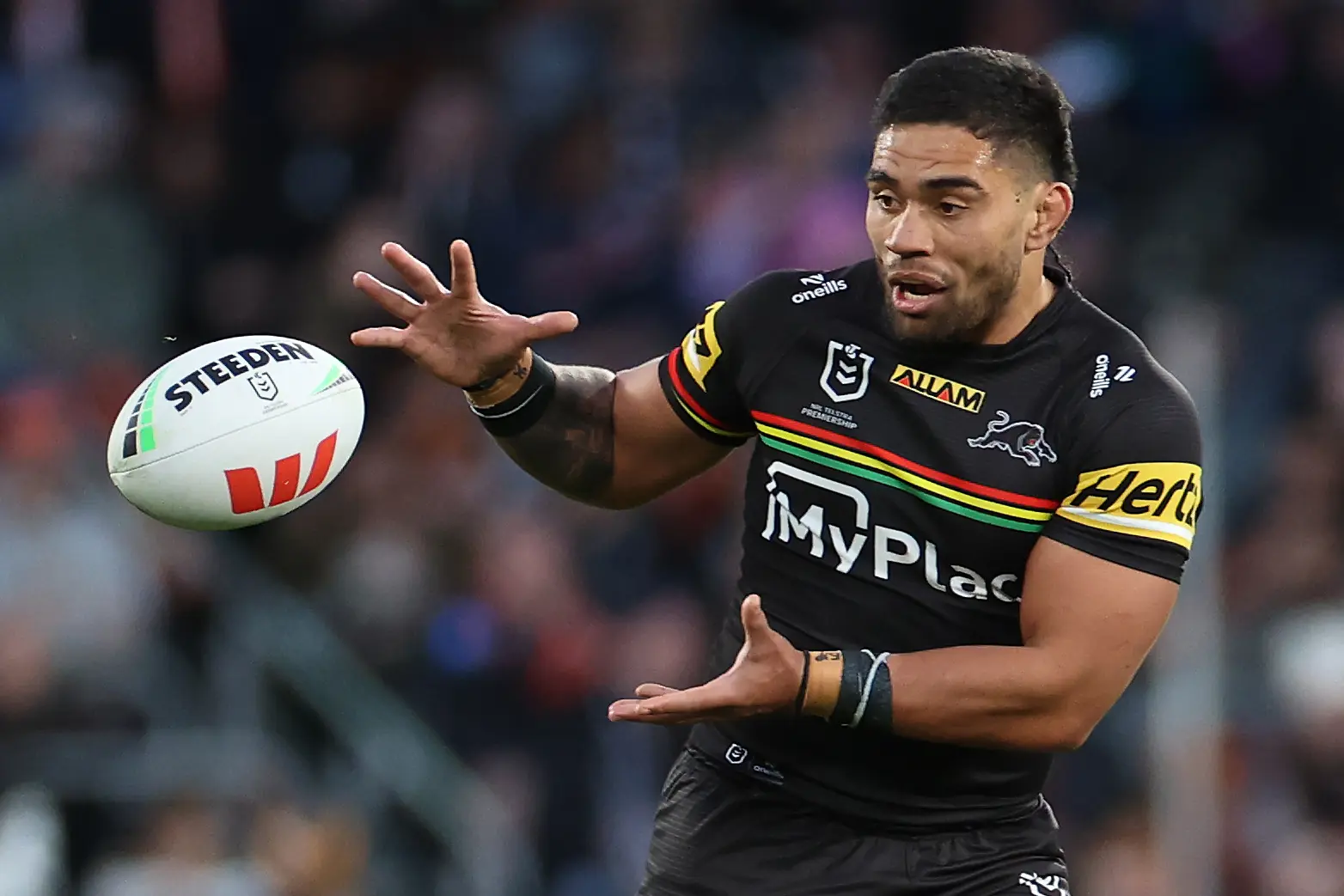
Isaiah Papali'i (Rugby League)
Before becoming one of the competition's best second-rowers or even joining the NRL, Isaiah Papali'i suffered a fibula compound fracture at just 15 years old.
The injury occurred during a development rugby league match long before his NRL career started, requiring surgery to insert a metal plate into his ankle and lower leg.
Fearing that his career was over before it started, Papali'i endured a long rehabilitation process that saw the Brisbane Broncos drop their recruitment plans for the youngster.
His mother and former Kiwi Ferns and Warriors second-rower, Lorina Papali'i, told NRL.com that Isaiah had to learn how to run again in his year-long rehab.
"It was six months to a year really where he had to completely learn to run again. It was hard, solid rehab where he had to completely learn how to put trust in that part of his body, the bone had to heal," Papali'i said.
"There was a lot of tears shed because you feel like the dream is over when you're injured in that way."
Despite the setback at such a young age, Papali'i went on to debut in the NRL at 18 years old for the New Zealand Warriors. His career is an amazing achievement and story, especially considering his Dally M Second-Rower of the Year-winning season in 2021.
Joe Theismann (American Football)
Joe Theismann was a quarterback for the Washington Redskins from 1974 to 1985, where he won a Super Bowl and received many MVP Honors.
During a match against the New York Giants in November 1985, Theismann was sacked by linebacker Lawrence Taylor and suffered a career-ending compound fracture of his right tibia and fibula.
The gruesome vision showed a clear snap of the leg and was worsened by Theismann becoming trapped under a pile of players. Taylor became very distressed after Theismann was uncovered from the pile and could be seen frantically waving for medical assistance.
Theismann was in a cast for three months and was subject to intensive rehabilitation therapy with the goal of returning to Washington. Doctors estimated his bone growth would take 12 to 18 months to fully heal. In July 1986, Theismann failed a team physical in an attempt to return to the NFL, and doctors believed his bone was too weak to return.
Ultimately, he had sustained insufficient bone growth, leaving his right leg slightly shorter than his left and forcing him to retire.
Speaking on an episode of Sports With Friends for The Underdog, Theismann expressed how the injury changed his life course.
"1984, I'm the fourth highest paid player in the National Football League at a million dollars a year... so all of a sudden I'm Joe Theismann who thinks he's pretty darn important," Theismann said.
"Then the injury occurs, and I find out that you're not as important sometimes as you really think you are, and it was a very humbling moment for me.
"In my case, I had become very full of myself, and my leg being broken really changed the course of my life and gave me a greater perspective on what really is important."
Following his retirement in 1985, Theismann went on to become a successful sports broadcaster, corporate motivational speaker, and entrepreneur.
John Porch (Rugby Union)
John Porch is an Australian rugby union player who suffered a serious compound fracture and dislocation of his ankle while playing for the Northern Suburbs Colts in Sydney in 2013.
Aged only 18, Porch was tackled from behind during the match and had his ankle trapped between the defender and the ground. The outside back recalls not knowing the severity of the injury and being on his way to the operating theatre.
He remembers the doctors discussing possible amputation, according to SportsJoe.
"What I was told was that when I was first going into the operating theatre, they were thinking of amputation. The doctor that did the surgery was Dr. (Stephen) Ruff," Porch said.
"He came in the day after my surgery, doing the rounds, and said, 'The surgery went well but it looks like you'll probably never play rugby again'.
"That just absolutely killed me."
Porch spent ten months in rehabilitation and said it was one of the toughest periods of his life. He was paired up with Greg Craig, a former Wallabies physiotherapist, for his rehab, who told Porch he would be back in the game within 18 months.
Porch exceeded these expectations and returned to rugby union in ten months. He described his recovery as a choice between giving up rugby or committing to the rehabilitation.
Following his rehabilitation process, Porch continued playing for Sydney clubs, including the North Harbour Rays, which allowed him to be noticed by Australian Rugby Sevens selectors.
Less than two years after his compound fracture, Porch was selected to represent Australia in Rugby Sevens. He would go on to compete at the Rio Olympics in 2016.
"It was unbelievable to be told you were going to the Olympics and going to be representing your country," he said.
David Busst (Soccer)
David Busst was an English defender for Coventry City in the English Premier League from 1992 to 1996. During a match against Manchester United at Old Trafford in April 1996, he suffered one of the most horrific injuries in the history of football.
Less than two minutes into the game, he went to attack a corner kick but collided with Manchester United players Denis Irwin and Brian McClair.
He suffered severe compound fractures to both the tibia and fibula in his right leg and punctured the skin with his shin, which had become noticeably bent.
The match was paused for just under ten minutes while he was stretched off the field and blood was washed off the pitch with sand and water. The goalkeeper for Manchester United, Peter Schmeichel, ended up vomiting on the pitch after seeing the injury.
Busst reflected on the shocking moment during a piece for ITV Sport.
"Shock. I remember screaming out; I remember by screaming the pain is not going away," Busst said.
"It was just horror."
Busst had to undergo 24 surgeries, which included ten within the first 12 days of his hospital stint. He also battled a severe MRSA infection that essentially destroyed a quarter of the muscle mass in his right leg.
Amputation of Busst's leg was considered; however, his leg was able to be saved through surgery. The damage caused to his leg was enough to officially retire the defender from professional football in November 1996
Years later, Busst managed to return to football by playing casual Sunday league and veterans' football.
With Cleary suffering the most significant injury of his career, his road to recovery will be long, with predictions of at least six months without further complications.
With recent confirmation, he is out of surgery and has let followers know he is grateful for the support via Instagram.
"I'll be back," Cleary wrote.
Promising signs from the representative.