Every player, junior or senior, needs a mouthguard at training and on game day, and the Australian Dental Association (ADA) rates custom-made guards, made from a mould or scan of your teeth, as the most protective.
If a tooth is knocked out, check the player for concussion and other injuries first. If they are awake, alert, and calm, put the adult tooth straight back in or keep it in milk, and see a dentist immediately, ideally within 30 minutes. Never put a baby tooth back in.
It happens in a split second. A shoulder comes in high, heads clash in a tackle, or a player gets caught by a stray elbow at the play-the-ball. The game keeps going, but on the sideline someone is holding a front tooth and wondering what to do next.
Across more than 100,000 de-identified treatment records at Pure Dentistry from 2015 to 2026, the most common dental emergencies were toothache, facial swelling from infection, and chipped and broken teeth.
The two upper front teeth were chipped more often than any others. These records cover all patients, not just sports injuries, but in a contact sport those are the teeth most exposed to a hit.
A de-identified review of clinical notes from Pure Dentistry and Kids Dentist Brisbane from 2022 to 2026 found 858 dental injuries, most of them in children. Where the injured teeth were recorded, 85% of cases involved the two upper front teeth.
Of 28 adult teeth that were knocked out, 20 were put back in, but 16 of the 28 later needed root canal or other nerve treatment, so even a saved tooth can need ongoing care. Sport caused 48 of the injuries, and none of those notes recorded the player wearing a mouthguard.
Based on our statistics on patients who call Pure Dentistry for dental appointments, we have found the following. Between August 2024 and November 2026, 31 callers told us a tooth had been injured during organised sport, including rugby league, soccer and basketball, and none said they had been wearing a mouthguard at the time. It is a small, self-reported sample, not a study.
Why do the front teeth take the damage?
Because they sit furthest forward. The upper front teeth often take the first impact from a knee, a shoulder or the ground. The ADA says a mouthguard absorbs and spreads the impact of a blow to the face, which helps prevent injuries to the teeth and jaw, including broken jaws and cuts to the lips and tongue.
A 2019 review of studies of athletes across a range of sports found that dental injuries were less common among players who wore mouthguards. The studies were observational, so they show a link rather than proof.
Should players wear one at training too?
Yes. Opposed sessions, tackle drills and touch games at the end of a session all involve contact. The ADA advises wearing a mouthguard during training and on game day. Clubs can adopt the joint ADA and Sports Medicine Australia mouthguard policy, which makes mouthguards compulsory ("no mouthguard, no play").
Which type of mouthguard is best?
A custom-made mouthguard. Here is how the three main types compare.
| Type | How it is made | Fit and protection |
| Stock | Ready to wear, from chemists and sports stores | Not shaped to your teeth, so it can sit loosely, protect less and make talking, breathing and calling for the ball harder. |
| Boil-and-bite | Softened in warm water as the packet directs, then shaped by biting into it | Often fits poorly, and home moulding can leave some parts thinner than others. |
| Custom-made | Made from a mould or 3D scan of your teeth taken at your dental practice | Fits your mouth only. The ADA rates it as the most protective and easier to breathe and talk in than store-bought guards. |
Some health fund extras policies cover part or all of the cost of a custom-made mouthguard, sometimes with a limit of one per year, so check your cover before the season starts.
When should a mouthguard be checked or replaced?
Whenever it stops fitting snugly. A mouthguard should stay in place without you biting down to hold it. Have it checked at your dental practice if:
- it rubs, hurts or makes you gag
- it falls out or feels loose
- it has been chewed, torn or worn thin
- you have had dental work, such as a crown or braces.
The ADA says a well-kept mouthguard can last several seasons, but only once you have stopped growing. Junior players should have theirs checked regularly, because adult teeth are still coming through and the jaws keep growing.
Rinse the guard in cool or warm water after each use, as hot water can soften and reshape it. Store it dry in a case, out of direct sun, write your name on the guard and the case, and bring it to dental check-ups.
What should you do if a tooth is knocked out on game day?
Check the player first, because a hit hard enough to knock out a tooth can also cause a concussion or a neck injury. The Concussion Recognition Tool used in sport advises assuming a neck injury is possible with any head injury. If the player has neck pain, or tingling or weakness in the arms or legs, don't move them, and call 000.
Healthdirect advises calling triple zero (000) if the player was knocked out, even briefly, has a seizure, vomits more than once or has fluid coming from the nose or ears. Call 000 or go to an emergency department for trouble breathing, talking or swallowing, a lot of blood going down the throat, or a very swollen mouth or tongue.
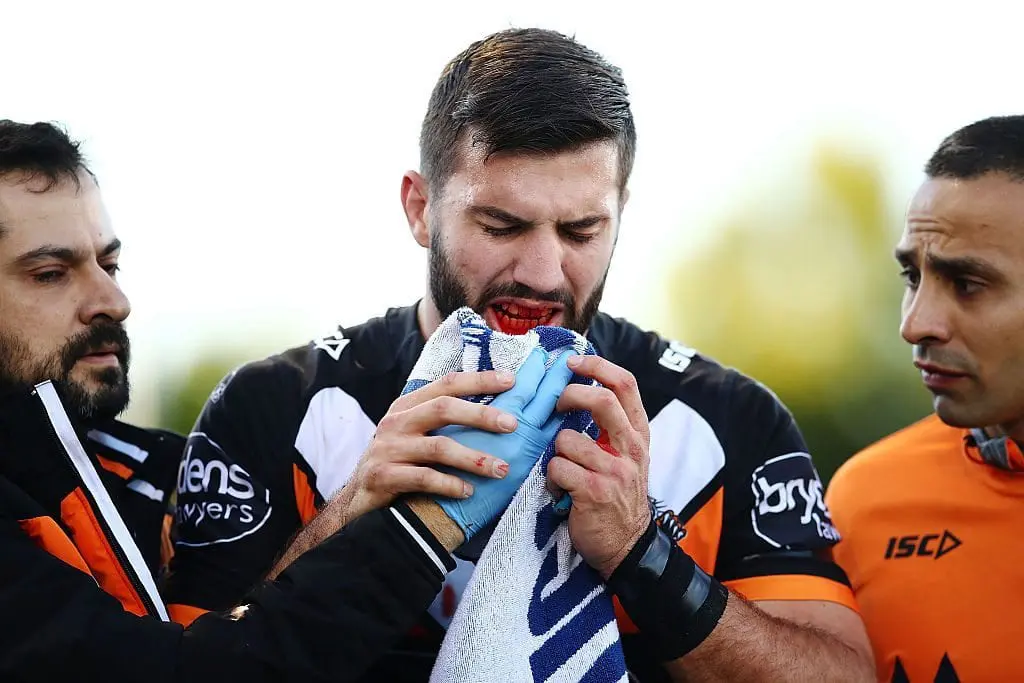
Australian concussion guidelines say any player with a suspected concussion must be removed from play, medically assessed and not return that day: if in doubt, sit them out. The Australian Institute of Sport's 2024 position statement says that in youth and community sport, players should be symptom-free at rest for 14 days before contact training, and wait at least 21 days before playing competitive contact sport again.
If it is an adult tooth
- Hold the tooth by the crown (the white part). Don't touch the root.
- If it is dirty, rinse it briefly in milk or saline. Don't scrub it.
- If the player is awake, alert and calm, gently push it back into the socket the right way round, then have the player bite softly on gauze or a clean cloth.
- If it won't go back in, keep it in milk, saline, or the player's saliva spat into a cup. Never let it dry out, for example by wrapping it in a tissue. Water is a poor choice, but international guidelines say it is better than letting the tooth dry.
- See a dentist immediately. The ADA advises trying to be seen within 30 minutes. If you cannot reach a dentist, go to a hospital emergency department, even if more time has passed, as the tooth may still be saved. Also ask a doctor whether the player needs a tetanus booster.
If it is a baby tooth
Adult front teeth usually come through between about 6 and 9 years of age, so a junior player's knocked-out front tooth could be either kind.
Don't put a baby tooth back in. International dental trauma guidelines advise against it, mainly because a child could breathe the tooth in, and replanting can also harm the adult tooth developing underneath. Keep it in milk and see a dentist as soon as possible.
If you are not sure which kind it is, keep it in milk and phone a dentist straight away. If the injury needs more treatment, your dentist may refer your child to a specialist paediatric dentist, such as Dr Ellie Nadian.
Young or anxious children sometimes have that treatment with happy gas (nitrous oxide), sedation or a general anaesthetic in hospital, which practices such as Sleep Dentistry Brisbane arrange. Your dentist will explain the benefits and risks.
If you can't find the tooth, tell the dentist, as it may have been pushed up into the gum, swallowed or breathed in. If the child is coughing, wheezing or having trouble breathing, call 000.
If a tooth is chipped, loose or pushed out of place
Find any broken piece if you can, keep it in milk or saline and bring it with you, as it can sometimes be bonded back on. Hold a cold pack against the lip or cheek to ease swelling. A loose tooth, or one pushed in or out of line, needs a dentist as soon as possible, as there may be damage to the root or bone.
Keep an eye on the tooth over the following weeks, too. A tooth that turns grey or dark, or a gum boil near it, can be a sign the nerve has been damaged. In our clinical notes, about one in five injuries later showed a problem like this, so have it checked by your dentist or, for a child, a practice such as Brisbane Paediatric Dentist.
What should be in the sideline first aid kit?
A few small items cover most dental injuries on game day:
- disposable gloves
- a small container with a lid and a carton of long-life milk
- saline sachets for rinsing
- sterile gauze to bite on
- a cold pack
- the number of a local dentist who opens on weekends.
Tip: A carton of long-life milk takes up very little room in the trainer's kit and could help save a tooth.
About the author
Sarah Beach is an oral health therapist at Pure Dentistry, a dental practice in Brisbane. She has more than 25 years of experience in children's and adult dental care.
Her qualifications, as listed on the national register, are a Certificate in Dental Therapy from Queensland Health (1993) and an academic upgrade from the University of Queensland (2005).
She is registered with the Dental Board of Australia (AHPRA) as a dental practitioner in the oral health therapist, dental therapist and dental hygienist divisions. AHPRA registration number: DEN0000961747.
Sources
- Australian Dental Association. Sports mouthguards. teeth.org.au. Accessed 6 November 2026.
- Australian Dental Association. Dental trauma. teeth.org.au. Accessed 6 November 2026.
- Australian Dental Association and Sports Medicine Australia. Mouthguard policy for sports clubs. sma.org.au. Accessed 6 November 2026.
- Australian Dental Association. Tooth eruption charts (factsheet). teeth.org.au. Accessed 6 November 2026.
- healthdirect. Dental injury. Reviewed February 2026.
- healthdirect. Head injuries. Reviewed November 2025.
- Australian Institute of Sport. Concussion and Brain Health Position Statement 2024, and Australian Concussion Guidelines for Youth and Community Sport. Accessed 6 November 2026.
- Echemendia RJ, Ahmed OH, Bailey CM, et al. Introducing the Concussion Recognition Tool 6 (CRT6). British Journal of Sports Medicine. 2023;57(11):689.
- Australian Institute of Sport. Minimum criteria for removal from sport. Accessed 6 November 2026.
- Whiting N. Six things you could claim on dental insurance. Canstar. 9 September 2026.
- Fernandes LM, Neto JCL, Lima TFR, et al. The use of mouthguards and prevalence of dento-alveolar trauma among athletes: a systematic review and meta-analysis. Dental Traumatology. 2019;35(1):54-72.
- Fouad AF, Abbott PV, Tsilingaridis G, et al. International Association of Dental Traumatology guidelines for the management of traumatic dental injuries: 2. Avulsion of permanent teeth. Dental Traumatology. 2020;36(4):331-342.
- Day P, Flores MT, O'Connell A, et al. International Association of Dental Traumatology guidelines for the management of traumatic dental injuries: 3. Injuries in the primary dentition. Dental Traumatology. 2020;36(4):343-359.
Disclosure: This article was contributed by Pure Dentistry, where Sarah Beach practises and which provides custom-made mouthguards. Kids Dentist Brisbane, Brisbane Paediatric Dentist and Sleep Dentistry Brisbane, mentioned above, are run by the owner of Pure Dentistry, and Dr Ellie Nadian practises at Pure Dentistry. This article does not endorse any mouthguard brand or manufacturer. It is general information and does not replace advice from your own dentist or doctor. Practice figures come from a de-identified review of Pure Dentistry's treatment records from 2015 to 2026, its clinical records from 2022 to 2026, and our statistics of the patients who called our dental clinic for urgent dental appointments between August 2024 and November 2026.