


State of Origin always creates overreactions.
One game and suddenly players become heroes, coaches become geniuses and referees become public enemy number one.
The fallout from NSW's remarkable comeback victory in Origin One has largely centred around Kalyn Ponga's controversial send-off.
Queensland supporters believe Ashley Klein ruined the contest whilst NSW supporters believe justice was served. The truth, as usual, probably sits somewhere in the middle.
What interested me wasn't just the send-off itself, and I spoke more about this on this week's episode of The Loose Carry Podcast. My interest also centres on what happened afterwards.
For the first hour of the game, NSW looked exactly like a team from the 1990s.
They stuck rigidly to a structure despite the opportunities being constantly offered to them by the Queensland defence.
Such is the speed of the game these days, NSW often played the ball with one QLD player prone on the ground, and two others barely in position at marker. This is a scenario that leaves a defence very exposed, ironically, with one less defender! Often that defence line didn't even get into position in time.
Yet, when Ponga was sent off, NSW suddenly decided to see the space, and NSW did something that many teams do when they have to chase a game.
They threw structure out of the window and back their instincts.
For years on various platforms including this one I've spoken about how may of our players stuffle to see space at times. Indeed, it takes a send-off for most teams to immediately see an extra man and think they need to attack the edges.
They start forcing shifts, throwing big passes and searching for quick points.
The irony is that, in the modern game, the best way to attack twelve defenders is often exactly the same way you attack thirteen.
You follow the structure to get out of your danger zones.
You force the defence to make tackle after tackle with direct running.
You make them compress. You create fatigue. Then, the opportunities appear around about the halfway line.
For much of the first half NSW looked like a team constantly coming from their danger zone. They were straight-jacketed. Once Queensland lost Ponga, they became the team resplendent with the attacking talent we have all assumed they had.
Eventually the numbers advantage became impossible for Queensland to hide. The tries didn't come because NSW suddenly discovered some magical attacking shape. They came because Queensland eventually ran out of defenders.
But look at the game in the first hour again and you will QLD often ran out of defensive numbers, even with a full compliment of men.
The best teams in the NRL understand this. The best Origin teams certainly understand it.
The lesson for coach Laurie Daley is simple.
Don't wait for the opposition to lose a player to encourage your players to back their attacking instincts in the QLD half of the field.
You will see there's an extra man becomes valuable when you've forced the defence to lost control of the ruck.
QLD did that brilliantly in the first hour. NSW played in a straight jacket.
Ironically, the player whose dismissal changed the game also highlighted another issue that has been bothering me for years. Kalyn Ponga's tackle.
Before anyone jumps down my throat, this isn't about whether it dese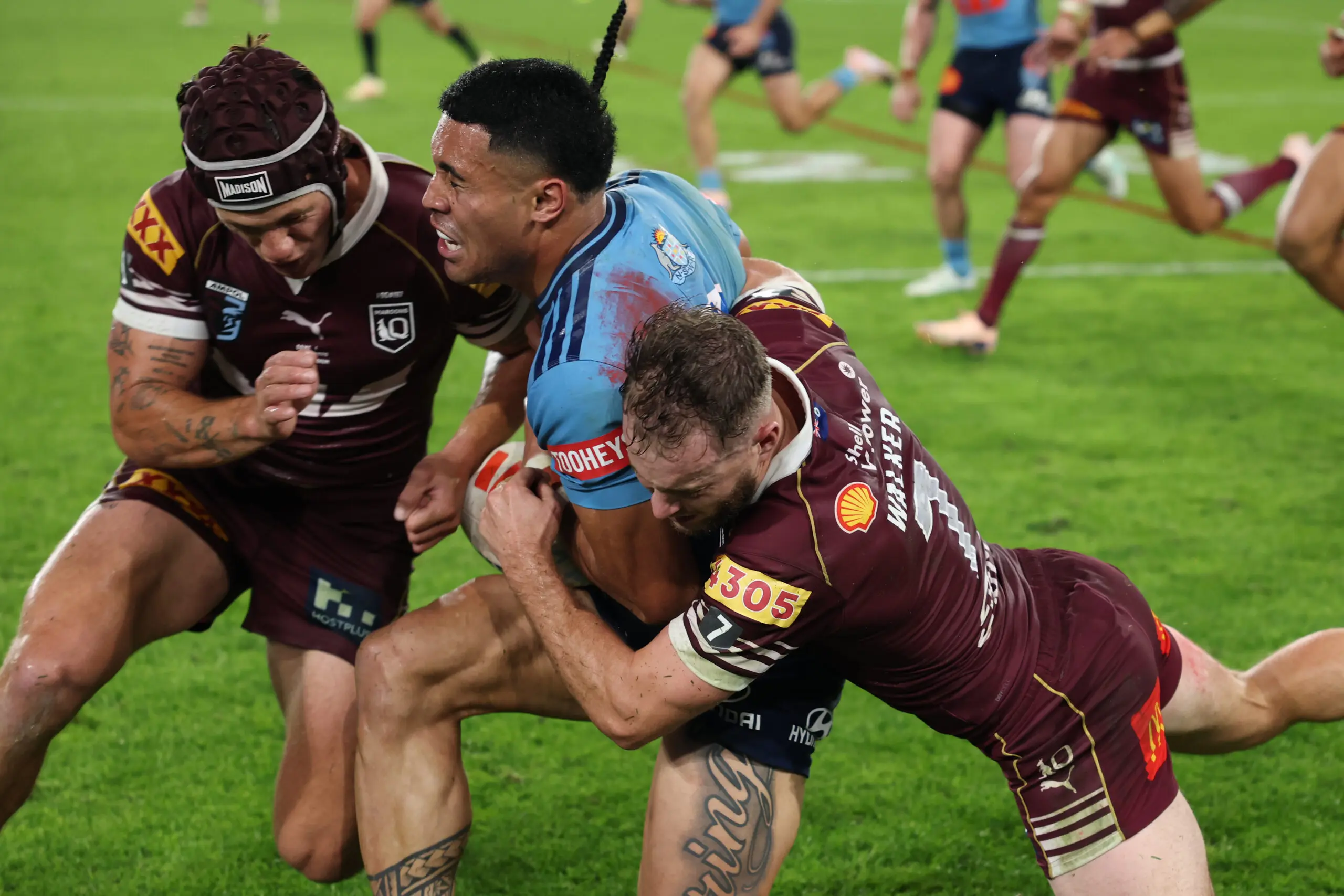 rved a send-off. Reasonable people can disagree.
Some saw a shoulder charge. Others saw a head clash. The NRL itself ultimately decided the incident warranted only a financial penalty despite the dismissal. The debate will continue for weeks, months, years.
What interests me is the technique. Watch the tackle again. Look at the body position. Look at the head in the wrong place and the lack of arm wrap. Look at the way the contact is initiated. Whether you believe it was a send-off or not, it wasn't good tackle technique.
And that's where rugby league has a problem.
As I said last week, a sport that is obsessed with systems over footballing technique and instinct. We talk endlessly about block shapes, sweep plays, kick pressure systems, defensive structures and yardage plans.
Yet many young players are arriving in senior football without mastering the core skills that underpin the game.
Passing. Catching. Tackling. Decision making.
The basics.
Go and watch junior training sessions around the country. You'll see teams rehearsing complicated attacking movements that some NRL clubs barely use. You'll see edge systems, shapes and patterns being coached in underage football.
What you often won't see is enough time spent mastering the fundamentals. Tackling, in particular, has become an area where we assume competence rather than teach it.
Yet our top players are bigger and faster than ever before and collision forces are greater than ever before, yet many tackle sessions are shorter than they've ever been.
Coaches understandably worry about injuries at training. They worry about contact load. They worry about player welfare which are all valid concerns.
But somewhere along the line we've confused reducing contact with coaching contact. They're not the same thing.
The safest tacklers in the game aren't necessarily the strongest athletes. They're often the best technicians. Their head placement is consistent. Their footwork on approach to the contact is efficient. Their body height is correct. Their arms wrap. Their shoulders connect. Their technique holds up under fatigue.
Those skills don't appear magically. They're coached, or at least they should be. One of the fascinating aspects of the reaction to Ponga's dismissal was how many people focused on intent.
"I know he didn't mean it."
"I'm sure he wasn't trying to hurt anyone."
"He was just trying to save a try."
All of those things can be true and were said after the game by various people in various comment sections. Intent isn't the issue. Technique is.
Most dangerous contact in modern rugby league doesn't come from malicious intent. They come from poor mechanics performed at high speed.
And that's why coaching matters in every corner of this country.
It's also why the conversation around player safety can't simply revolve around punishments and judiciary outcomes.
If we genuinely want safer players, we need better technicians. That starts long before Origin. On junior fields and in development systems. It starts with coaches valuing core skills as much as structures.
Origin 1 delivered two powerful lessons.

The first was that structure can restrict a team. NSW's comeback was built on embracing the chaos, even when emotions were running high.
The second was that fundamentals still matter.
In an era obsessed with systems, data and tactics, the game's oldest skills remain its most important.
Neither lesson should be forgotten before Game 2.
Lee Addison is a former club coach at Sea Eagles and Panthers and the founder of rugbyleaguecoach.com.au. He is a Coach Mentor and his programmes for coaches and clubs can be found HERE










Excellent, concise opinion piece.