


Rugby league has never been short of tinkering. From new rules to tweaked interpretations and experimental formats, the game's administrators are rarely content to leave well enough alone.
Some changes have drawn the kind of sustained, cross-generational criticism of the six-man bench, and last week's State of Origin clash has brought debate to a head.
The rule was sold as a safeguard, extra coverage for injuries, more potential flexibility, and a safety net for coaches navigating the brutal attrition of top-level football.
In reality, it created confusion, diminished the craft of team selection, and left genuine footballers watching from the sideline while the clubs went without them.
State of Origin has been a learning curve for the game in terms of tactics, why it is levels above the NRL club product and why certain players' game styles translate in the Origin arena when compared to others.
However, this rule has shown its true use and doesn't enhance the team selection and construction process; it bypasses it entirely.
To defend Laurie Daley for a moment, it is hard to know exactly how the game is to flow, what kind of players he needs and what adjustments he needs to make.
However, the changes he made mid-game were significantly exposed in Game 2.
"I think part of the strategy of coaching and picking a team is to cover all your bases and do it from there. I think the six-man bench is poor for club football," Phil Gould said on Nine's 100% Footy on Monday night.
"Because they've got so many options on the bench, sometimes they can second-guess themselves.
"What's happening is, they're not putting their player on until very late in the piece, because they want to cover their bases."
The Origin arena has exposed this most visibly.
NSW Blues Bench:
- Cameron Murray: 43 minutes (from 19th-54th)
- Victor Radley: 29 minutes (from 27th-57th)
- Addin Fonua-Blake: 9 minutes (from 55th-64th)
- Ethan Strange: 16 minutes (from 64th-80th)
- Api Koroisau & Jack Bostock, DNP.
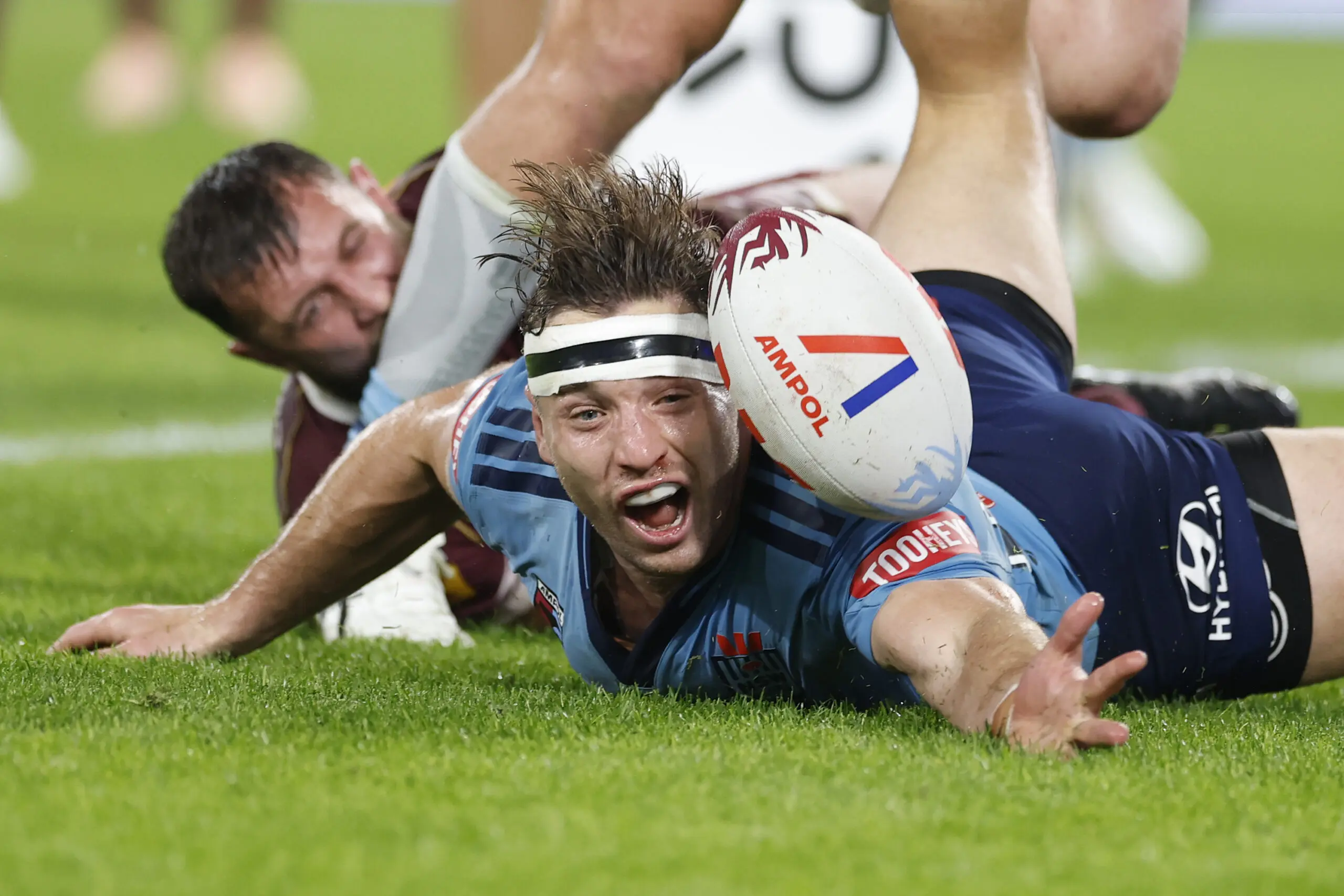
Laurie Daley copped heavy criticism for his interchange management in their loss to the Maroons, while Billy Slater was praised for his handling of Cameron Munster needing a HIA in the first half.
The concept itself has turned bench management into an overcomplicated risk mitigation rather than a genuine tactical weapon.
This, in a way, best described by Paul Gallen, is like a "get out of jail free card."
There is a toll on the players left watching. For the Blues, Api Koroisau didn't play, who could have been used in clubland, as the Wests Tigers played the Gold Coast Titans in Round 15.
For the Maroons, Reece Walsh didn't play for the Broncos against South Sydney Rabbitohs, even when the club tried to get an exemption for their premiership-winning star.
Considering the Broncos' season is on the line, the Brisbane fullback would have been valuable for his side.
Walsh was selected as the 18th man for Game 2, which the rules don't allow him to go back to clubland for the Broncos game, making it understandable in terms of the training leading into Origin when it comes to selection and who can play for their clubs if they are the 20th man.
Jack Bostock played for the Dolphins against the Sydney Roosters and was called into camp the next day due to Casey McLean's quad injury.
The players we are talking about are genuine stars and prolific players of the game, and essentially become sidelined twice over.
The arguments in favour of the six-man bench were convincing, and the issues needed to be addressed; they have a huge impact and value in games. NSW wouldn't have won game one without the six-man bench, with the incredible output of Casey McLean in the last 23 minutes to secure the 22-20 victory.
We're seeing the emphatic people in the game, like Laurie Daley, overthink benches consisting of players who don't play, and a generation of players not getting the game they need in the reserve grades to develop.
Earlier in the NRL season, the Bulldogs experienced games in which they made controversial decisions that exposed their poor adjustments.
The club spent time in the media publicly defending the mid-game adjustments, even though they had the players to perfectly shuffle the team to make it work without hurting their game plan.
Against the Knights in Round 4, they shuffled Matt Burton to centre and deployed Stephen Crichton at five-eighth in the second half, while having Sean O'Sullivan on the six-man bench.
Then, in Round 5 against the South Sydney Rabbitohs, Stephen Crichton hurt his shoulder, which was determined to be an AC Joint injury he has since been carrying, and Ciraldo decided to sub O'Sullivan into the centres as Crichton's replacement.
Between weird explanations and justifications of player switcheroo and the coaches not handling high-pressure scenarios where players get hurt and have to make a quick second decision, the game now offers more overthinking and less quality and creative thinking.
Rugby league is at its best when it demands versatility, resilience and genuine decision-making under pressure.
The rule has a need; it must and will stay, but we can also be honest about how it is really being used and the impact it has on the development of the rugby league product within the NRL ecosystem.










I barely watch footy anymore after over 50 years. Its on sometimes in the background. Its turned to crap. Sanitised everywhere i look.
HIA is good but the rest of rule changes is rubbish.
You can have the highest numbers with your ratings and your 9.30 pm finishes all to yourselves. But the grounds are still half empty every week most times.