For 40 minutes at the MCG on Wednesday night, it looked like Queensland might be staring down a series-ending 2-0 deficit.
By full-time, they'd put up 44 points, run in seven tries, and forced a decider at Suncorp Stadium.
The tactical analysis of how the Maroons got from one place to the other says as much about the team Billy Slater has built as any result in this series.
Game 1: Chaos in Sydney
To understand Game 2, you have to understand how Game 1 played out.
The narrative coming out of the opener wasn't that Queensland had been outclassed; instead, they'd been the better side for most of the night and still found a way to lose the match.
NSW started poorly, conceding tries in the opening twenty minutes and struggling before the contest turned on a single moment.
Kalyn Ponga was sent off for a high shot on Tolutau Koula with twenty-three minutes remaining, and being a man down, Queensland couldn't hold on, and the Blues escaped Sydney with a series lead they arguably hadn't earned across the full eighty minutes.
The Maroons were not a team searching for answers so much as a team that needed to finish what it had already shown it could start.
Game 2: First half scratchy, second half avalanche
For long stretches of the first forty minutes, that finished looked a long way off.
NSW led 12-8 at the break, scoring through Kotoni Staggs and Mark Nawaqanitawase off Queensland errors from a kickoff and a kick from Nathan Cleary at the end of a set.
Struggling for rhythm, the Maroons only scored from an early penalty goal by Sam Walker and a try to Trent Loiero that showed the brilliance of down-hill, fast-pace transition with ball-playing that opened up the middle third of the Blues' defence.
Then everything changed.
Selwyn Cobbo's line break in the first set of the second half didn't produce points; it altered the entire complexion of the energy this Maroons side was bringing.
Queensland didn't stop scoring, running in six tries in the second half to finish with 36 unanswered points in the term and a Cobbo hat-trick that was must-see TV.
The crafitness of Harry Grant, Cameron Munster, Kalyn Ponga and Sam Walker was striking.
Munster, who already set up Loiero's first try with an offload, similar to the offload he had in Game 1 that led to Sam Walker's try, spent the second half putting cross-field kicks at the ends of sets after playing a fast down-hill attacking sequence that hunted for matchups against weak defenders and a scrambling defensive line that put pressure on the Blues wingers to stop their matchups from scoring.
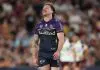
The Maroons captain found both Jojo Fifita, who was able to out-launch Brian To'o, who was on his back foot, and Selwyn Cobbo out wide to finish tries directly off his boot.
Sam Walker, playing just his second Origin match, finished the night eight from eight with the boot and produced a moment of pure audacity with an offload to Ponga off a scrum that fed straight into a two-on-one sequence where Ponga passed to Cobbo, who scored in the corner.
Harry Grant's awareness around the ruck and the ability to accelerate in a manner that is so sly, and finds markers not square and defenders in the wrong spots scrambling to correct their positioning to stop the Maroons' dummy half running through gaps in the Blues' defence, is a threat hard to contain and even more difficult to find a counter for.
Not only was the forward pack grinding it out with their running game in the middle to lay a platform for their backline one through seven to have a licence to play eyes-up footy, thanks to their own forward pack foundation.
The Queensland middles played huge roles with their running game, having three Maroons middles with 11 carries or more and combining for 563 metres with 69 runs.
Queensland's defence in the second half deserves as much credit.
Reuben Cotter was able to control the ruck and shut down NSW's go-forward in the middle of the field.
Max Plath added more than his ball-playing in attack, as he made 28 tackles coming off the bench.
Queensland's defensive line was built on playing high-up blitz coverage, with quick line speed every tackle of the set, which put Mitch Moses and Nathan Cleary under pressure as first and second receivers to make a playmaking decision, especially in their kicking games.
Flashes of the Mal Meninga system show in Slater's structure, focusing on discipline and territory control rather than only having the energy-based philosophy Slater's tenure has explored.
The Decider
Queensland now arrive at Suncorp Stadium with real momentum, they are fit and firing spine that didn't need the injection of Reece Walsh, and a defensive performance that showed they can shut down a game as well as they can light one up.
The series is level, the crowd will be theirs, and after losing a game they should have won in Sydney, the Maroons have shown exactly the kind of response Origin football demands.
Whether that's enough to settle the shield in Brisbane is still to be decided, but Queensland will take plenty of confidence from how comprehensively they answered the question that mattered after Game 1.