While the consensus among many in this country is that Australian Rugby League Commission Chairman Peter V'landys has done a great job running rugby league, this analysis continues to omit two major policy failings under his leadership.
The first of those is the failure to maximise the value of the game's media rights when compared to the AFL, despite the NRL being consistently the bigger television sport, and two, the inability to reinstate international rugby league to a meaningful position within the sport (an ongoing problem since the Super League War (SLW) of the mid-to-late 1990s).
It should be noted the NRL has an opportunity to rectify the former failure given a new media rights deal is currently under negotiation. The second issue, however, remains alive and unresolved under this administration.
One of the key (and continuing) consequences of the SLW was that international rugby league was allowed to fall by the wayside, as the Australian and English domestic competitions retracted into self-interest while leaving the connections between them to largely wither.
These connections, formed in the early years of last century, were the foundations of the international game. Ignoring them has proved extremely detrimental to the fabric of rugby league.
It has led to the ridiculous situation in which Australia and England have not met since the 2017 World Cup – nearly an entire decade of inactivity.
Essentially, interaction between the hemispheres remains spasmodic outside the vagaries of the draw at each World Cup.
During the SLW, the infrastructure of pre-SLW international rugby league collapsed, with the famous Ashes contest between Australia and Great Britain/England, fought for every two years on a home-and-away basis since 1910 except for the World Wars, allowed to lapse (thereafter being played irregularly and with little or no underlying thought as to the overall structure of international competition).
This effectively threw the Kangaroo Tours and Lions Tours of yesteryear, for so long such a cherished part of rugby league, into the trash bin of history.

While 2025 is scheduled to provide a Kangaroo Tour for the first time since (rather incredibly) 2003, the ongoing neglect of the international game is reflected in the fact that the venues for the English-based series were not settled until well under a year before the contests will take place.
The impact this might have on Australians wanting to travel with the Kangaroos is undeniable.
It is extremely difficult to plan to travel as a spectator for these types of events without schedules being secured at least one year out from the event itself. Previously, the regular nature of these events, once every four years for a Kangaroo Tour and vice versa for the Lions Tour to Australia, meant that expectations could naturally build, and spectators from each country could plan and save to travel for these events.
The completely arbitrary and piecemeal nature of current international scheduling makes such planning extremely difficult (especially in a cost-of-living crisis).
Accordingly, it is unlikely we will see the equivalent of the 10,000 Lions fans who made the Lions Tour to Australia in 1992 (which predated much of modern sporting travel including the 1994-95 Barmy Army in Australia in cricket) replicated at the end of this year in Britain for the Kangaroos.
Originally, of course, the international schedule was to see a proper rugby league Lions Tour to Australia in 2025 (for the first time since rather incredibly 1992), but this was ditched for unspecified reasons and belatedly replaced with a Kangaroo Tour of England, necessitating other changes to the (previously fixed) international schedule.
The relative decline of international rugby league can be directly traced to the loss of these major contests. While the World Cup has been elevated to an extent, its existence is very much determined by the attitude of the NRL to it at any given time.
Even now, almost nothing has been heard about the planning for the 2026 World Cup in Australia.
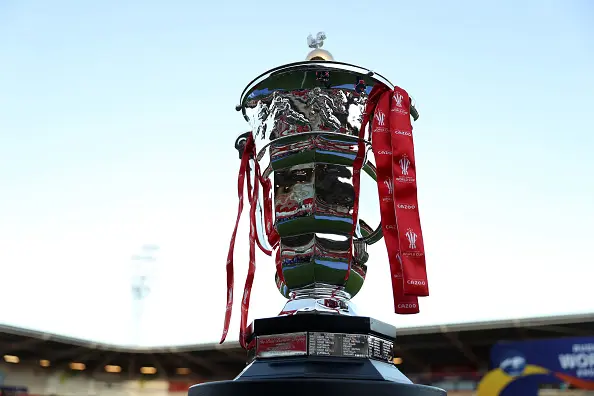
The unconscionable meddling in the timing of the last World Cup by Australia should not be forgotten quickly. That the entire international rugby league schedule can be dispensed with as inconvenient by supposedly its biggest advocate is not a tenable position if the international game is to prosper. And while the International Rugby League (IRL) remains beholden to the NRL, this position threatens to continue.
The reduced visibility of rugby league from the international space for the best part of a generation (30 years) has resulted in an entire generation of followers failing to appreciate the value of this sector of the game, hence greatly undermining its economic value to the game as a whole.
Kangaroo Tours have drawn up to 140,000 for a three Test series in England – indeed, this figure has been limited by stadium capacity. In both Kangaroo Tours of 1990 and 1994, the third Test of each series was played at Elland Road in Leeds and the capacity of 32,500 (1990) and then 40,000 (1994), severely limited the number of tickets that could be sold for the sold-out deciding games. It was widely reported that these games could have sold at least double the number of tickets given the demand.
This considerable source of revenue has effectively been untapped by rugby league since 1994, 31 years ago. Subsequent Kangaroo Tours in 2001 and 2003 were much reduced and rushed affairs played at smaller grounds.
This amounts to a critical failure on the part of the international rugby league community, but especially the NRL which whether one agrees with it or not, continues to constitute the real power and wealth behind the world game.
Peter V'landys ought to ensure the NRL does everything possible to support international rugby league, in both hemispheres, which means establishing a fixed international program which is then adhered to – to the letter – so as to give other competing nations a decent chance of improvement by way of fixed timelines and playing opportunities.
The tradition of “leaving the northern hemisphere to the Poms” is counterproductive and largely futile. Much of the game's funding is currently tied to the southern hemisphere. The value in northern hemisphere rugby league commodities remains largely untapped.
The French, previously a major draw card which drew over 450,000 to their Australian Tours in the fifties, twice, have been reduced to a pale shadow of those world-beating sides.
The Australian administration has gone from the days of Chair Ken Arthurson (“We will never forget French rugby league and will always support it") to the days of Chair Peter V'landys (“Sorry we just cancelled that Test we promised you in 2025 and I'm sure a couple of days training with Kevin Walters will suffice”) – a stark example of where the current administration is lacking.

Despite the protestations of the Rugby League Players Association, an expansion of the touring squad could have still allowed a game against the French to proceed in 2025 (as originally promised) had the administration taken the view that it was of sufficient importance. Ultimately, it was not and so the game was quietly scrubbed.
The rugby league Lions Tour is another example of a valuable economic resource which rugby league has allowed to evaporate. Few people will be aware that for the vast bulk of the twentieth century, the rugby league Lions Tour in Australia was clearly in the ascendency when compared to its rugby union equivalent.
The attempt to highjack sole use of the “Lions” name by rugby union amounts to both rugby league insouciance and typical rugby union arrogance. In fact, both codes have a long history of “Lions” Tours to Australia since the early 1900s (union previously had a one-off Lions Tour that also played a large number of Australian Rules games at the end of the nineteenth century).
For nearly the entirety of the twentieth century, one “Lions Tour” was in fact far more important in Australia than the other: the rugby league version.
From the time rugby league commenced in Australia in 1908 until the end of the twentieth century, rugby union hosted a mere five Lions Tours to Australia in total – 1930, 1950, 1959, 1966 and 1989. The 1930 “Test series” was actually a one-off Test and the 1989 series was a full three-Test series – otherwise, the 1950, 1959 and 1966 Lions Tours in rugby union each consisted of only two Tests between Australia and the Lions team.
In clear contrast to this inconsistency, Australian rugby league hosted nineteen Lions Tours over almost the same period (ie. between 1910 – 1992), with these Tours being set at regular four-yearly intervals for that entire period (interrupted only by World Wars One and Two).
The regularity of the rugby league Lions Tours over such a lengthy period is telling.
Moreover, on all but the 1910 Tour (during which the Lions played two games against Australia and two games against Australasia), a full three-Test series was held between Australia and the Lions side (57 rugby league Lions Tests in total, compared to a tiny ten against the Lions in rugby union over roughly an identical period of time).
The pre-eminence of the rugby league Lions Tour in this period is well established.
After World War Two, the Australian federal government pressed the British House of Commons to send a rugby league Lions team to Australia as soon as possible, to boost the country's low morale following years of war.
Accordingly, passage was quickly arranged on an aircraft carrier travelling to Australia (the HMS Indomitable), given transport was otherwise nearly impossible to secure, and the rugby league Lions toured as early as 1946 (less than a year after the Pacific War had ended). The rugby union Lions did not tour Australia for another four years.
The relative interest in the two versions of Lions Tours in Australia during the twentieth century were poles apart, with rugby league clearly the dominant Lions brand in Australia in terms of spectator and general interest. Test attendances for the rugby union edition of the Lions in Australia are below.
1930, Test 1, 30,712 (SCG)
1950, Test 1, 20,000 (Gabba)
1950, Test 2, 20,000 (SCG)
1959, Test 1, 20,000 (Ekka)
1959, Test 2, 15,521 (SCG)
1666, Test 1, 42,303 (SCG)
1966, Test 2, 15,000 (Lang)
1989, Test 1, 39,433 (SFS)
1989, Test 2, 20,525 (Bal)
1989, Test 3, 39,401 (SFS)

Not one of these games represents a full house at the grounds involved. Indeed, from the start of rugby league in Australia in 1908, until the end of the use of the Sydney Cricket Ground (SCG) in 1987, rugby union never attracted a crowd of 50,000 to the main ground for both sports in Australia, the SCG; in contrast, rugby league had hundreds.
Test matches between Australia and the Lions in rugby league always seriously tested (and regularly exceeded) ground capacities throughout Queensland and New South Wales.
The SCG had a comfortable capacity of around 50,000 throughout most of the twentieth century, subject to how many people the police allowed to cram into the huge grass expanse of “The Hill”.
This was no obstacle to more than 60,000 inevitably attending rugby league Test matches involving the Lions at the SCG. By way of example only, the largest crowds were the dangerously large ones at the 1932 First Test (70,204), the two all-ticket Tests of 1958 (68,777 and 68,720), and the First Test of 1962 – watched by 70,174.
The massive interest in the rugby league version of Lions Tours in Australia was reflected not only in the Test attendances, but in the fact that games between Sydney and New South Wales rugby league teams and the rugby league Lions also far outstripped Lions rugby union Test matches against Australia in terms of attendance.
The biggest attendances for Sydney and New South Wales rugby league teams against the Lions also stretched right across the twentieth century but are well illustrated by the likes of the Metropolitan/Sydney vs Lions game of 1920 (67,859) and the NSW v Lions match of 1950 (an extraordinary attendance of 70,419).
Without listing the attendances across all 57 Test matches involving Australia and the rugby league Lions, it is quite obvious that interest in the rugby league Lions across the twentieth century in Australia far exceeded that of their rugby union counterparts.
The effective capitulation on rugby league Lions Tours to Australia has seen a consequent inability to maximise revenue out of this part of the game. It also marks a significant failure to differentiate the more internationally diverse rugby league offerings from those of the, exclusively domestic, AFL – its major competitor.
While Peter V'landys has done a good job with respect to the redevelopment of the club game of which Las Vegas is a good example, and in the continued strength of the Origin concept at the State level, one third of rugby league's potential – the international game – remains significantly undervalued.
If Peter V'landys wishes to establish a more lasting legacy as chairman of the ARLC, the reinstatement of international rugby league to its proper place remains a glaring oversight which must be rectified.

While some international growth can be achieved through the likes of the PNG NRL franchise and potentially a second New Zealand NRL side in Christchurch (at a later date), club rugby league should not be the only way to champion rugby league development around the world.
The international game must remain at the forefront of this endeavour if rugby league is to achieve its full potential.
What is needed from the NRL is lending true support, and attaching real importance, to the scheduling of in-season international games between the major nations across the hemispheres, rather than merely reducing the international component of the game to an out of NRL season add-on, which acts merely as an ancillary and largely unwanted part of the overall sport's structure.
This will also necessitate funding commitments to the international game being expanded by the NRL, so as to improve the prospects of international teams other than the Kangaroos.
The obvious potential of international rugby league will be clearly illustrated in Britain in October and November of this year. The second and third Tests sold out in record time, and it seems likely the Wembley first Test will break the current international crowd record in England (the 74,468 who watched the neutral World Cup Final clash of 2013 between the Kangaroos and the Kiwis at Manchester's Old Trafford ground).
Frankly, it is well past time that Peter V'landys and the Australian Rugby League Commission took a proper interest in international rugby league, and beyond the imperialist overtones of simply “buying” the European Super League at under value.
There is infinitely more potential in the international sphere of the game than any other aspect of rugby league at this time.
Peter V'landys has, so far, failed to properly address these important issues. Certainly, in international matters, the current administration is a mere shadow of the Arthurson/John Quayle/Bob Abbott years in which countries like Fiji actually commenced playing the game (1992).
As I pointed out in 2008 at the Rugby League World Cup Conference in Sydney, the game has been extremely fortunate to have achieved great organic success due to the demographics of mainly the Pacific diaspora in Australia and New Zealand.
But the key to international expansion of the game is that this continued organic growth needs to be matched by administrative support which has been until now sadly lacking. Rebuilding the international infrastructure needs to be an important part of that support.
The Australian Rugby League Commission needs to start to work with the IRL more cooperatively to properly formulate international scheduling, adhere to it, promote it and thereby grow the game around the world. Until it does this, the game is robbing itself of both valuable funds and potential further exposure around the globe.